People want a stable and durable roofing material for their roofs. Corrugated roofing proves an effective option. Its wave-like pattern, DIY installation, and functionality make it further appealing. Interested in Roof Maintenance Services?
However, before panicking, you should learn how to install corrugated metal roofing. Beginners are often unaware of this method, which impacts their roofing installation procedures. Also, learn about Roof Inspection Services.
Corrugated Metal Roof: How To Install Corrugated Metal Roofing?
The following are the details to understand how to install corrugated metal roofing.
Roof Surface Preparation
Examine your roof to ensure it’s:
- Clean.
- Stable.
- Dry.
You need to remove old roofing materials. Also, install a moisture-resistant underlayment or roofing felt over the roof deck. You can get extra protection from water penetration. Secure the underlayment using roofing nails and staples. You must also ensure that no availability of wrinkles or gaps are left. Installing a foam closure strip at the eaves and ridge offers better moisture control and a secure installation.
Measure And Plan Your Layout
Successful installation is possible with accurate measurements. Consider the roof’s length and width to understand how many panels you need. These panels are available in standard width, so thoroughly plan the panel layout to avoid cuts and waste. Use a chalk line to mark vertical lines on the roof deck where you want to place the panels. It also helps in keeping the rows straight during installation.
Also, read: Residential Roofing Service.
Install The Metal Panels
Start from one bottom corner. Position the first metal panel so that it overhangs the eaves by about 1-1.5 inches. Use galvanized screws with rubber washers to secure it. And place it in flat areas of the panel, not on the ridges.
Proper spacing between screws is also essential. Place new panels over the previous ones by at least one ridge. And continue installing up the slope and across the roof. Ensure proper panel alignment with your chalk lines for consistency.
Visit Rooffixer for further details.
Trim And Flash
You need to trim panels. You can do it by using metal shears or a circular saw with a metal cutting blade. Install flashing around:
- Roof edges.
- Valleys.
- Ridges.
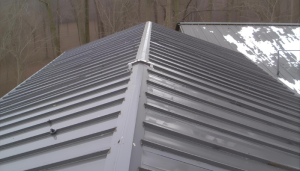
It helps prevent water penetration. Ridge caps must be secured at the roof peak and overlapped by both sides of the panels.
Inspect And Seal
Now, inspect the entire roofing to see if anything is missing and needs your attention. You can use silicone or butyl sealant on rough seams and penetrations for additional security.
What is the biggest problem with metal roofs?
Metal roofs are popular for their durability, energy efficiency, and modern appearance. However, many homeowners ask, “What is the biggest problem with metal roofs?” One of the main issues is noise. During heavy rain, hail, or wind, metal roofs can produce significant sound, which may be disruptive if proper insulation is not installed. Another common concern is expansion and contraction. Metal panels expand and contract with temperature changes, which can cause fasteners to loosen over time, potentially leading to leaks or structural issues.
Proper installation and underlayment are key to mitigating these problems. Many people also wonder, “What do you put under a corrugated metal roof?” Typically, a roofing underlayment, such as synthetic felt or ice-and-water shield, is installed beneath the metal panels. This layer provides additional protection against moisture, prevents leaks, and improves insulation and energy efficiency. In some cases, a layer of rigid foam insulation or a sound-deadening mat is added to reduce noise.
While metal roofs offer long-lasting protection and aesthetic appeal, addressing the biggest problems with metal roofs and using the correct underlayment beneath corrugated panels ensures performance and longevity. Proper planning, installation, and maintenance are essential to enjoy the benefits of a metal roof for decades.
How Far to Overlap Corrugated Metal Roofing?
Homeowners, contractors, and other professionals often wonder, “How much to overlap corrugated steel roofing?” Because proper overlapping of metal roofs is crucial for leak prevention and durability. For most corrugated panels, the sidelap should be one complete corrugation. The edge lap should be at least six inches. If you live in a region with heavy rain, strong winds, or snowfall, the increase of end laps to 8-12 inches will provide better weatherproofing and water resistance.
Side Lap Requirements
Panels are connected horizontally by side laps. It is recommended to overlap by one full ridge. This allows water to flow off without getting between the panels. Installers often apply waterproof sealant or butyl adhesive along the sides of the panels to improve the barrier’s long-term durability.
End Lap Requirements
The end laps are used to connect the panels vertically. In most climates, a 6-inch overlap will suffice, but in areas of severe weather, an 8-12 inch overlap may be required. Using quality screws and ensuring proper fastening space will help to prevent separation.
Conclusion
To conclude, how to install corrugated metal roofing? This type of roofing material requires proper planning for installation. It’s a simple procedure with accurate measurements. It offers durability and long-term solutions with minimal maintenance requirements.